The right contact depends on what happened, not simply on which company name you found online. A guest with an incorrect order, an applicant waiting for an interview and an employee with a time-record question need different information and may need different channels.
Sizzling Platter's official corporate contact page and jobs hub are useful starting points, but Service Line Journal is an independent publication, not a support desk. We cannot access orders, applications or employee records. Do not submit private account, payment or identity information through an unrelated editorial website.
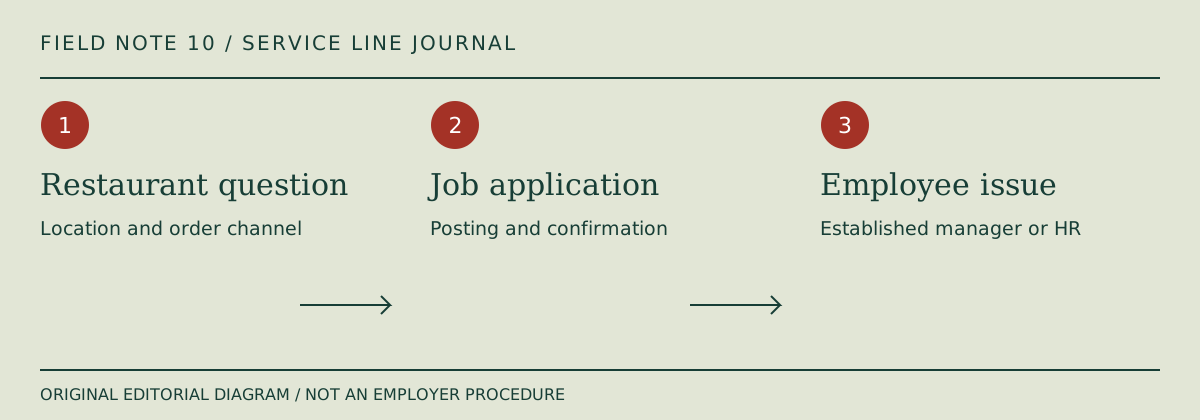
For an order or restaurant visit
Start with the restaurant brand, exact location and the channel used to place the order. Have the date, approximate time and order reference available. If an order came through a delivery platform, check that platform's support route as well as the restaurant's instructions; do not assume the operator can directly change another service's transaction.
Explain the issue factually and say what help you are requesting. Avoid sharing full card numbers or unnecessary personal details. For current menu, opening-hour or accessibility questions, use the selected restaurant's official information. A corporate portfolio page is not a single menu for all the brands it lists.
For a job application
Return to the confirmation and posting associated with your application. Identify the job title, restaurant address, application date and reference number if one was supplied. Use the stated follow-up route where available. The official jobs hub is a better starting point for a new search than a message from an unknown recruiter.
The company contact page publishes corporate contact details, including a recruiting email, but that does not establish a guaranteed application-status service or response time. Ask a concise question without attaching sensitive documents unless the receiving party and the need for them have been confirmed.
For an employee issue
Use the confirmed workplace process for scheduling, time records, training or other employment matters. If you do not know that process, ask your manager or established HR contact to identify it. Keep the relevant dates and facts, and distinguish what you observed from what you inferred.
A pay issue may also warrant consulting the Department of Labor's official restaurant guidance. An urgent safety problem should not wait for a routine email response: follow the workplace's immediate safety procedure and contact local emergency services when the situation requires urgent assistance.
A short message structure
- Identify the correct restaurant or employer and your relationship to the issue.
- State what happened, including the relevant date and reference.
- Explain the specific question or action you are requesting.
- Give an appropriate reply method without including unnecessary sensitive data.
- Keep a copy and note any promised next step.
Verify unexpected replies
A logo, familiar company name or urgent tone does not prove that a sender is authorized. If a reply unexpectedly asks for money, credentials or sensitive information, verify it through independently obtained official contact details. The FTC's job-scam guidance is particularly relevant to recruitment messages. Clear routing and careful verification reduce confusion without assuming that every delay or unfamiliar domain is fraudulent.
Choose one owner for the next step
A problem can involve several businesses without every business being able to solve every part. For example, a fictional delivery order might involve the restaurant, an ordering platform and a payment provider. Start by identifying where the order was placed and what the confirmation says about support. Ask which party can perform the specific action you need, such as checking preparation status or explaining a refund request.
If you contact more than one party, keep the account consistent and mention any existing case reference. Do not present a request as a completed promise or seek duplicate reimbursement for the same issue. Record what each party actually said it would do. This avoids confusion when a restaurant can explain the food preparation but a separate service controls the order's payment record.
Use a short, factual inquiry
For an application, a useful draft might read: “I applied for the crew role at the restaurant on [street] on [date]. My confirmation reference is [reference, if supplied]. Could you tell me whether there is a stated next step or whether further information is needed?” Replace only the fields you actually know and send it through the confirmed application route. This is an editorial example, not an official company form.
For a restaurant issue, describe the date, location, ordering channel and the concrete discrepancy. State what resolution you are asking about without adding allegations you cannot support. A concise message makes it easier for the recipient to understand the issue; it does not guarantee a refund, interview or response time.
A follow-up needs new context, not a larger audience
Before following up, check whether the original response gave a time or a different contact route. Refer to the existing reference and identify what remains unanswered. If the promised date passes, a brief follow-up can ask for the current status. Copying unrelated corporate or recruiting addresses may expose more personal information without reaching someone who can act.
If the first recipient says another team owns the issue, ask for an official destination or an internal transfer where available. Verify any new destination before sending sensitive records. When no response time has been stated, avoid treating silence as confirmation that an application succeeded or that a complaint was accepted.
Stop before turning a private issue into public data
A public review or social-media post is visible beyond the people handling the issue. Before posting, remove order references that expose account access, employee details and payment information. Stick to your own experience and distinguish facts from interpretation. For a serious workplace or legal matter, an appropriate confidential channel may be more useful than a public comment thread. An independent editorial publisher cannot investigate private records merely because the company's name appears in the article.
Continue reading
How to Find Official Sizzling Platter Jobs Safely
What Is Sizzling Platter? The Company Behind the Restaurant Names