Sizzling Platter is a restaurant franchise operator, rather than the name of one restaurant menu. Its corporate website describes a franchise growth platform: a business that operates and develops restaurants associated with established brands. Understanding that distinction makes a job search, company lookup or customer question much easier to route.
The words can also mean food served on a hot platter. This guide concerns Sizzling Platter, LLC, the restaurant business. It is an independent explanation, not a company announcement, application service or official customer-support page.
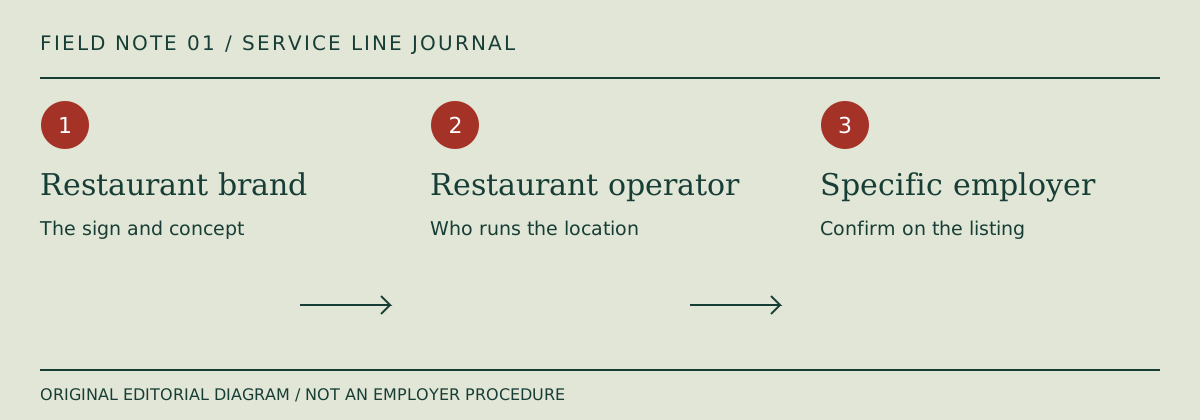
Three names can describe one restaurant
A restaurant can have a familiar brand on the sign, an operating company responsible for the location and a separate investment owner behind that operating company. Those roles are connected, but they are not interchangeable. A franchise operator's portfolio does not mean it owns every restaurant using those brands, or that it owns the national brands themselves.
For a job applicant, the practical question is which business is employing people at the specific address. For a guest, the first useful details are the brand, restaurant address and order information. Searching only the operator's name can lead to a corporate page when a local restaurant is the more useful contact.
What the dated record establishes
The company's history page traces its beginnings to 1963. A July 2, 2025 Bain Capital announcement reports a partnership in which Bain Capital North American Private Equity was acquiring the business from CapitalSpring. The announcement said Nathan Garn would continue as chief executive and that financial terms were not disclosed.
That release described more than 800 locations in the United States and Mexico at the time of the announcement. It is a dated snapshot, not a verified current restaurant count. Older corporate pages display other approximate totals. A reader comparing them should not turn those figures into an exact present-day census or assume every difference signals a business change.
Choose a source for your actual question
- For a company overview, begin with the official corporate homepage and About page.
- For employment, use the official jobs hub and check the specific brand, location and role.
- For a restaurant visit, confirm the individual restaurant's current hours and menu through that brand's official channels.
- For a corporate question, consult the company's published contact page and explain the purpose clearly.
A useful ownership check
Imagine finding a vacancy for a familiar pizza brand near home. Before assuming Sizzling Platter operates that restaurant, read the employer name and location in the posting. Ask for clarification if the recruitment page and interview invitation identify different businesses. A recognizable logo alone cannot answer the employer question.
The same discipline helps with research. Use a dated announcement for a transaction, a current posting for a vacancy and the restaurant's own information for a visit. Each source answers a different question. This guide connects those sources; it does not replace an offer letter, official company statement or restaurant confirmation.
Operator, brand and investor: different questions
Think of the brand as the identity a customer recognizes and the operator as the business running a particular restaurant. In a franchise arrangement, these roles can belong to different organizations. The investor sits at another level: an ownership relationship with the operating business does not turn every restaurant brand in that business's portfolio into an investor-owned national chain.
This distinction explains why a corporate announcement may name several familiar brands while a job offer uses a less familiar legal entity. Neither difference automatically indicates an error. It creates a verification question: does the posting, interview invitation or offer identify the employer for the location you intend to join? If the documents disagree, ask the hiring contact to explain the relationship before treating the matter as settled.
A guest has a different question. Knowing who operates a restaurant may help with an escalation, but the order usually needs to be identified by the restaurant, date and transaction details. A broad corporate inquiry that leaves out the brand and street address may be difficult to route. Company research is most useful when it helps you supply the right context, rather than replacing the local information needed to solve the problem.
Read the company timeline at the right level
The official timeline places the beginning of Sizzling Platter in 1963. It identifies Red Robin in 1993, Little Caesars in 2007 and Dunkin' in 2010. Later entries describe Little Caesars in Mexico in 2014, Wingstop in 2015, Jersey Mike's in 2021, and Jamba and Cinnabon in 2022. These are dates in the operator's story, not the founding dates of those restaurant brands.
That difference matters if you are preparing an interview answer or writing a company profile. Saying that Sizzling Platter's timeline associates a brand relationship with a particular year is a narrower, better-supported statement than saying the company created the brand that year. The timeline is also not a complete record of every acquisition, opening, closure or ownership change.
Several older or undated pages use approximate scale figures. The history page contains references to both two and three countries, while the dated 2025 Bain announcement describes the United States and Mexico. For a present-day introduction, there is no need to reconcile every historic figure into a speculative total. Identify the source and date, and use precise current location information only when it has been separately confirmed.
What the Bain announcement does and does not tell you
The July 2025 announcement is useful evidence for the investment transaction and for how the business described its scale at that time. It is not a current directory of restaurants, a hiring forecast or a promise about employment conditions. It cannot tell an applicant whether a nearby store has a vacancy today or whether a particular role offers a certain schedule.
It also says the financial terms were not disclosed. That limits what an editorial guide can responsibly state as an established transaction fact. A rumored valuation from another period should not be silently substituted for the release's position. The same principle applies to management titles: a dated release can establish who was named in that announcement, but it should not automatically be rewritten as an independently verified leadership roster years later.
A hypothetical applicant's route
Suppose Maya sees a job advertisement for a restaurant brand she knows and then discovers the name Sizzling Platter in an employer description. Her first step is to match the job title and restaurant address with the posting reached through the official jobs hub. The company name helps her understand the relationship, but it does not remove the need to confirm the exact role.
Next, she saves the posting and notes the application provider. If an interview invitation arrives, she compares its role and location with that record. At the interview, she asks who the employer is, where training takes place and whether the role covers one restaurant or more than one. These are ordinary clarification questions, not signs that she distrusts the employer.
If the location or role changes during the process, Maya evaluates the new details rather than assuming her original understanding still applies. A different commute, schedule or reporting location could affect her decision even if the restaurant brand remains the same. This example is hypothetical and illustrates a verification method, not a reported Sizzling Platter hiring process.
Match the question to the evidence
- Company identity: use the corporate homepage and the company's own explanation of its business.
- Historical development: use the official timeline, keeping brand-entry dates separate from brand founding dates.
- Ownership announcement: use the dated Bain release and preserve its limits on undisclosed terms.
- Current application route: use the official jobs hub, then the specific live vacancy.
- Employment conditions: use the relevant posting, hiring-team clarification and written offer materials.
- Restaurant service: use the exact brand and location rather than a company-wide assumption.
What you should not infer from a portfolio
Shared operation does not establish that different restaurant brands use interchangeable menus, loyalty benefits, prices or hiring requirements. It also does not prove that two restaurants with the same sign have the same operator. Those are separate facts that require location-specific confirmation. A useful company guide makes these boundaries visible instead of making the organization appear simpler than it is.
For applicants, this leaves a practical order of work: understand the business, find the right route, examine the actual opportunity and confirm unresolved details. For guests, begin with the restaurant and transaction, then escalate with that context if necessary. In both cases, the goal is to use the corporate name as a navigational aid rather than as a substitute for the details that determine the answer.
Before sharing a company summary with someone else, check that its wording preserves these distinctions. A sentence about historical scale should retain its date. A list drawn from the jobs hub should say where it came from. A description of employment conditions should identify the actual vacancy or offer rather than imply that a general corporate page establishes those conditions everywhere.
Continue reading
Sizzling Platter Brands: Reading the Portfolio Without Guesswork
Finding the Right Contact: Restaurant, Recruiting or Workplace Issue?